
Finding Ramsey County Residents
No one public file establishes every member of a household. In Ramsey County, the strongest first step depends on what is already known. A current address points to the parcel and tax records. A full name can be checked against property, court, business, and historical sources. An old Saint Paul address may be better served by a directory volume and map than a current lookup.
Keep results separate by what they prove. A tax record identifies an owner or tax name, not every person at an address. A deed documents a recorded transaction. A court result identifies a party and case activity, subject to access limits. That distinction stops a residents directory search from turning a likely match into a mistaken identity.
- Confirm the address, parcel, and legal description in county property sources.
- Save the owner or tax name, then check recorded instruments in RecordEASE.
- For a person, search MCRO with name variants and compare the case details.
- For an earlier household, use library and FamilySearch directory material.
- Ask the responsible office for existing public data when an online index ends.
Note: A matched name is a lead, not proof, until the address, date, and record type agree.
Ramsey County Resident Records Offices
The county’s property offices are the practical center for address work. The Recorder and Registrar of Titles keeps real-estate instruments and connects them through RecordEASE. The Assessor and property-tax services connect a parcel to a current tax record. Elections maintains local voting administration, while MNVotes is the state route for a person to check registration. These offices hold different evidence, so their results should not be treated as interchangeable.
Ramsey County Recorder
Recorder and Registrar of Titles
Saint Paul, MN
651-266-2050
Ramsey County Assessor
Property valuation and classification
Ramsey County, MN
Verify current contact with county
Ramsey County Parcels First
MapRamsey is the proper start when the work begins with a place. Its public map brings together tax parcels, classifications, valuations, current and historic aerial imagery, oblique views, environmental layers, administrative boundaries, and points of interest. Locate the parcel, then preserve the PIN and legal description before moving to a tax account or recorded deed.
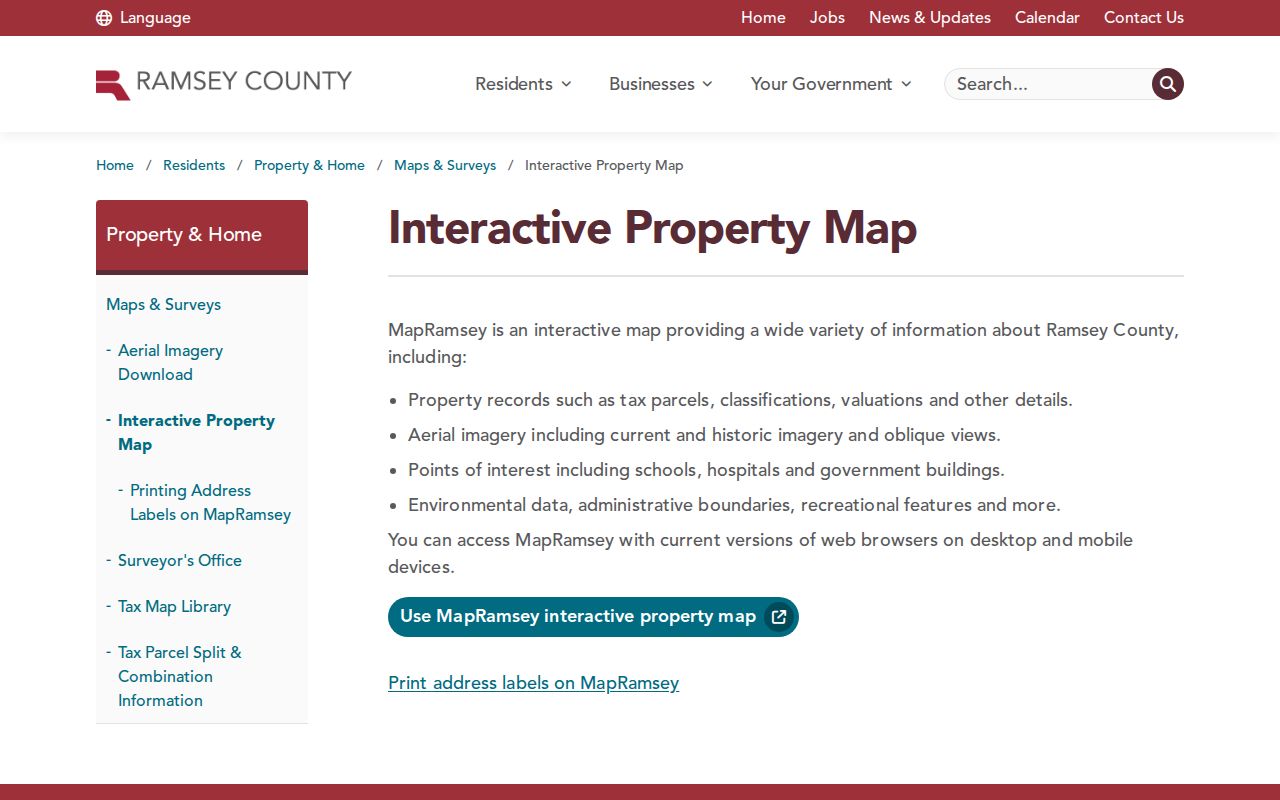
The parcel view gives spatial context, but it does not identify every resident. Mailing address, situs address, and legal description may describe different parts of one property record.
Ramsey County Property Search Fields
The captured property-search routes accept more than one starting point. Use an address when the place is known, a PIN when a prior result supplied it, or plat, block, and lot information when an old deed uses a legal description. A legacy result example also accepts any part of the name on a tax statement. Verify the returned parcel before relying on the tax name.
| Field | Format | Ramsey County use |
|---|---|---|
| Property address | Text | Find and confirm a situs address |
| PIN or parcel number | County identifier | Move between map and property account |
| Plat, block, lot | Legal-description fields | Bridge a subdivision or older record |
| Name on tax statement | Text | Find a tax-name lead, not household proof |
- Parcel or PIN
- The county identifier for a taxed property.
- Situs address
- The physical location of the parcel.
- Index
- A finding tool that points to a record; it is not always the image.
- Criss-cross directory
- A historical directory arranged from address to occupant.
RecordEASE Links Names to Land
After the parcel is confirmed, the recorder’s RecordEASE routes a name or legal description into deeds, mortgages, liens, plats, and related instruments. The useful backward method is grantor and grantee searching: find the current owner’s acquisition, record the seller and legal description, then search that seller as a prior buyer. Addresses are helpful leads, but lot, block, addition, and parcel changes control the chain.
The captured public page showed no extra charge for basic web search/viewing. Its subscriber schedule lists $25 per month, $0.85 for a document or certificate search, and $1 for a viewed document, certificate, or plat. Electronic recording began April 24, 2014, so older instruments may require deed books, tract indexes, county staff, or library and archive routes.
The RecordEASE search surface shows the county book, page, and document-retrieval route.
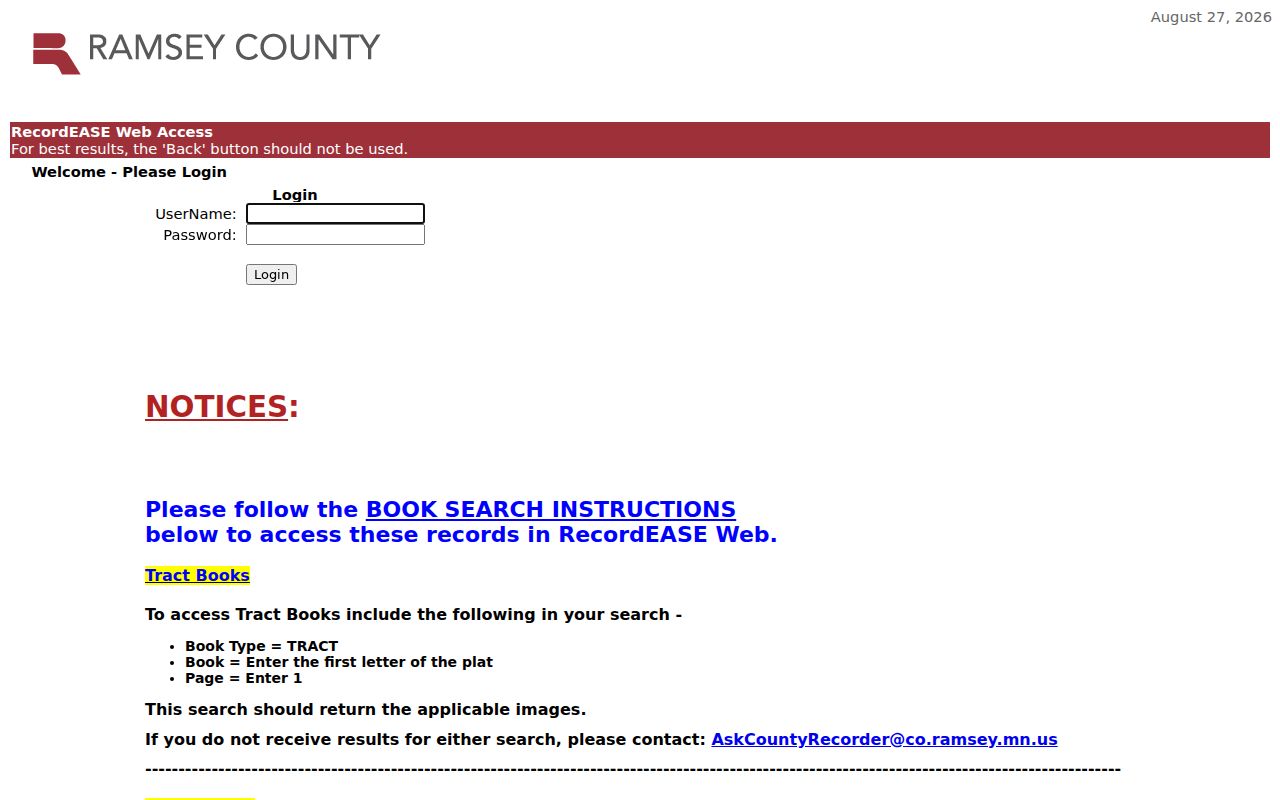
Use the index to locate the recorded item, then read the instrument before describing a transfer or relationship.
Ramsey County Voter Data Limits
MNVotes lets a person check registration and voting information. It is not a Ramsey County street census. Minnesota Statutes §201.091 governs the public information list. It allows specified fields for eligible users who identify themselves and certify a permitted use, while exact birth date, email, and identification data stay private.
The same law bars putting a public voter list into an Internet-searchable database and restricts sale, transfer, and use. Safe at Home, withholding, and inactivation options also mean a name may not appear in a public-list result. Treat election material as a narrowly controlled record, not as a general residents directory.
Minnesota’s registration lookup is the official personal-verification route.
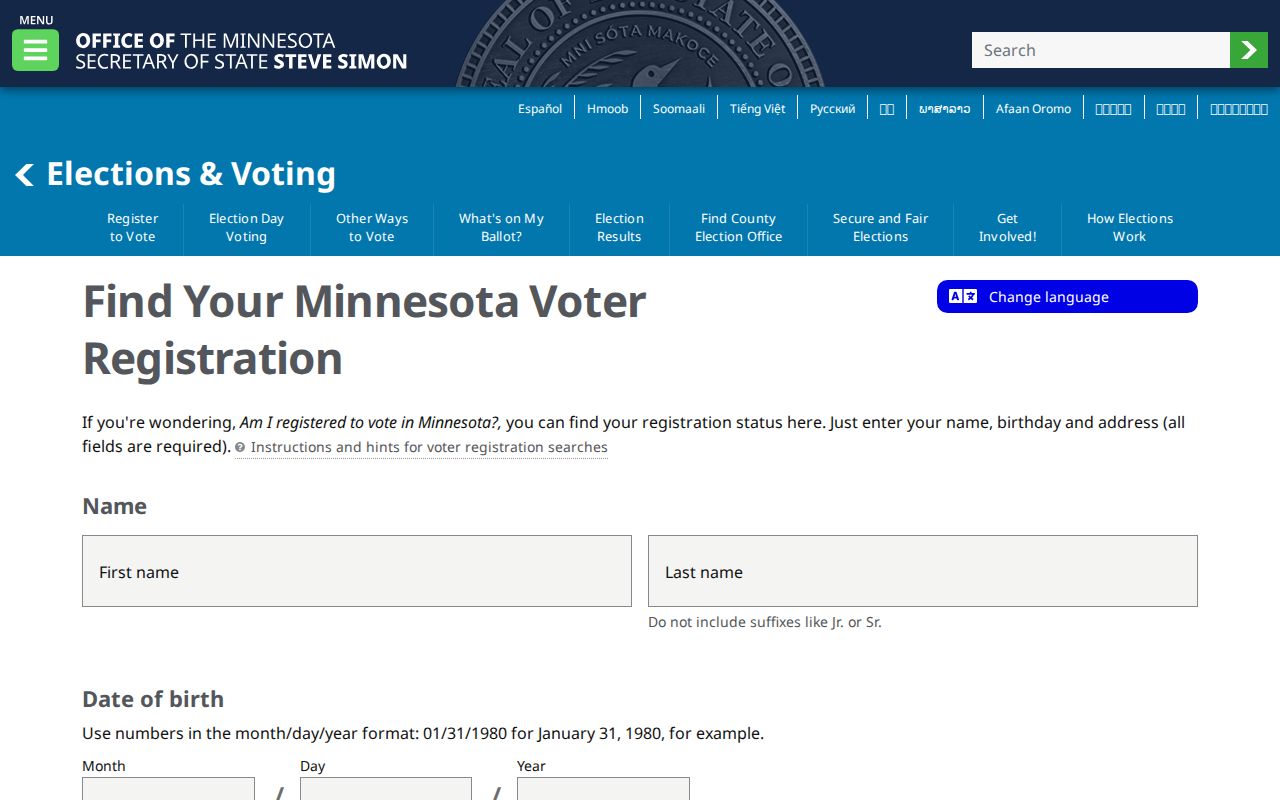
The state form asks for information that verifies an individual’s registration; it does not open a block-by-block roster.
Current Ramsey County Resident Directories
Current sources are specialized rather than universal. A property tax account can associate an owner or tax name with a parcel. The recorder lists parties to instruments. Court files identify parties and case events within public-access rules. Voter material has particularly strict conditions. The table matches a Ramsey County residents directory question to the source that can actually answer it.
| Source | What it can confirm | Keeper | Access route |
|---|---|---|---|
| Property tax and value record | Owner or tax name, parcel context | Ramsey County | Public property lookup |
| Recorded instrument index | Grantor, grantee, legal parcel, date | Recorder | RecordEASE and older-record channels |
| Court case record | Party, filing, case activity | Minnesota Judicial Branch | MCRO or courthouse terminal |
| Voter public information list | Statutorily allowed fields | State and county elections | Restricted request under §201.091 |
| Business or license record | Public affiliation or filing | State agency or board | Official portal |
To verify one person rather than follow an address, the Ramsey County resident lookup process compares these sources while accounting for aliases, same-name matches, and protected records.
MCRO Remote and Courthouse Records
Minnesota Court Records Online, called MCRO, offers statewide Case, Document, Hearing, and Judgment Search. A public result can identify a case number, case type, court location, party role, filing date, Register of Actions, hearing information, judgment details, and public documents. A case type alone does not establish an outcome, and a certified copy comes from court administration.
MCRO’s remote name search is deliberately narrower than courthouse terminals. Pending criminal, traffic, and petty-misdemeanor matters without a conviction do not return in defendant-name case or hearing searches. Remote results omit party street addresses and protected categories. Search with and without a middle name, try a wildcard after two characters or Sounds Like, then use a case number or terminal when official instructions call for it.
MCRO public access is the active statewide court-search platform.
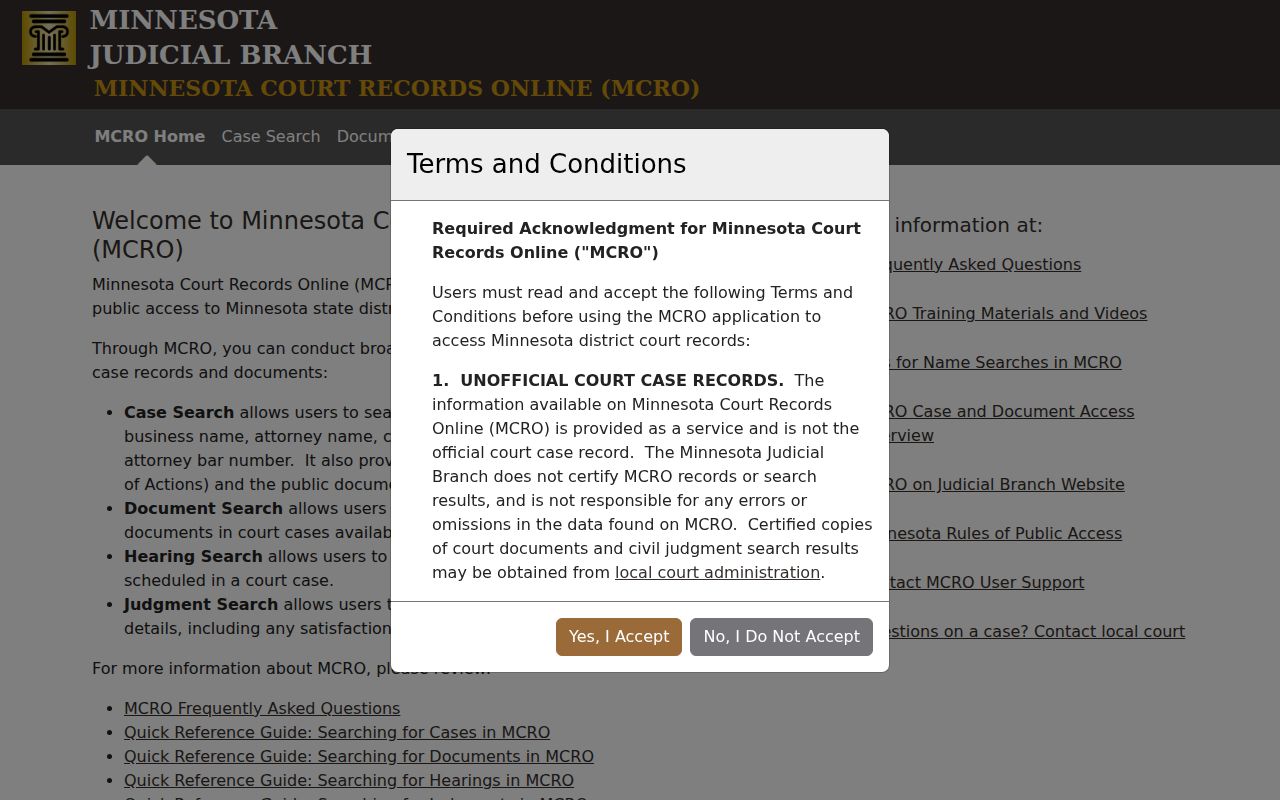
MCRO replaced MPA Remote in 2023 after phased search features began in 2021 and 2022, which explains why older directions may point elsewhere.
Ramsey County Vital Record Routes
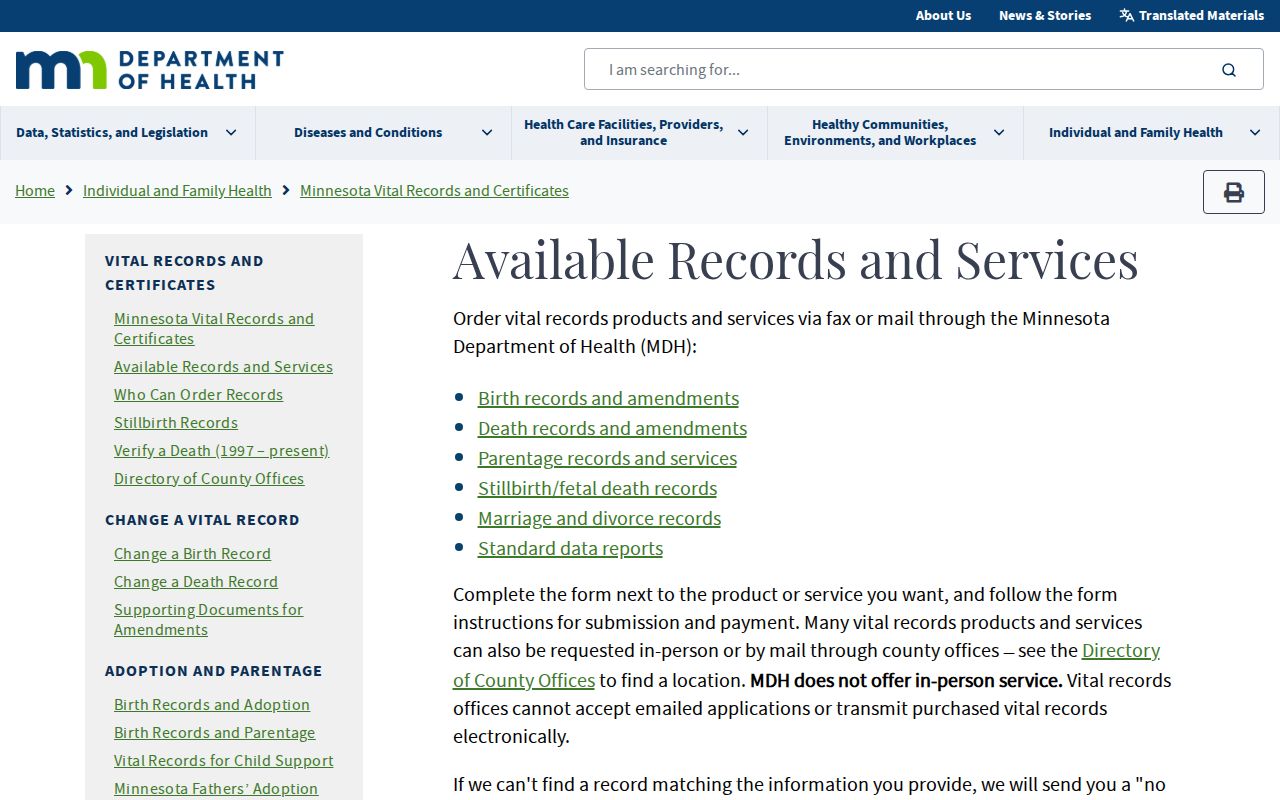
Vital records have different custodians. The Minnesota Department of Health handles statewide birth and death products, while Ramsey County Vital Records issues local products. A marriage certificate comes from the county that issued the license. A divorce decree comes from the district court that granted it. The Minnesota Official Marriage System is a discovery index, not a replacement for the licensing county’s certificate.
Birth and death copies require a signed request, payment, identity or attestation, and an eligibility category under Minn. Stat. §144.225. MDH accepts mail or fax and does not offer email applications or in-person service. Its current service page publishes processing information, and a county vital-record office may offer a local in-person or mail route.
MDH’s product and application page separates the available birth and death request choices.
For family research, Minnesota People Records Search provides historical index access for births from 1900 through 1934 and deaths from 1904 through 2001.
Saint Paul’s Historical Resident Shelf
For earlier households, the Gale Family Library in Saint Paul is the central local-history route. Its walk-in resources include genealogy databases, the 1895 Minnesota State Census index, Digital Sanborn maps, newspapers, county and local-government records, and Minnesota vital indexes. The FamilySearch St. Paul catalog leads to directory books and related holdings. Ramsey County Historical Society adds local photographs, manuscripts, maps, and subject files.
Printed directories can show a surname, given name, spouse notation, occupation, employer, and street address. They are annual snapshots, not guaranteed proof of legal residence. Read each volume’s abbreviation key, search surname variants, and pair a directory year with census, map, obituary, or deed evidence. The fuller collection treatment is in the Ramsey County Directory Book.
The FamilySearch catalog is a documented route to Saint Paul directory material.
The catalog is useful when a needed year lies outside a digitized run or needs an affiliate-library visit.
Ramsey County Custody Window
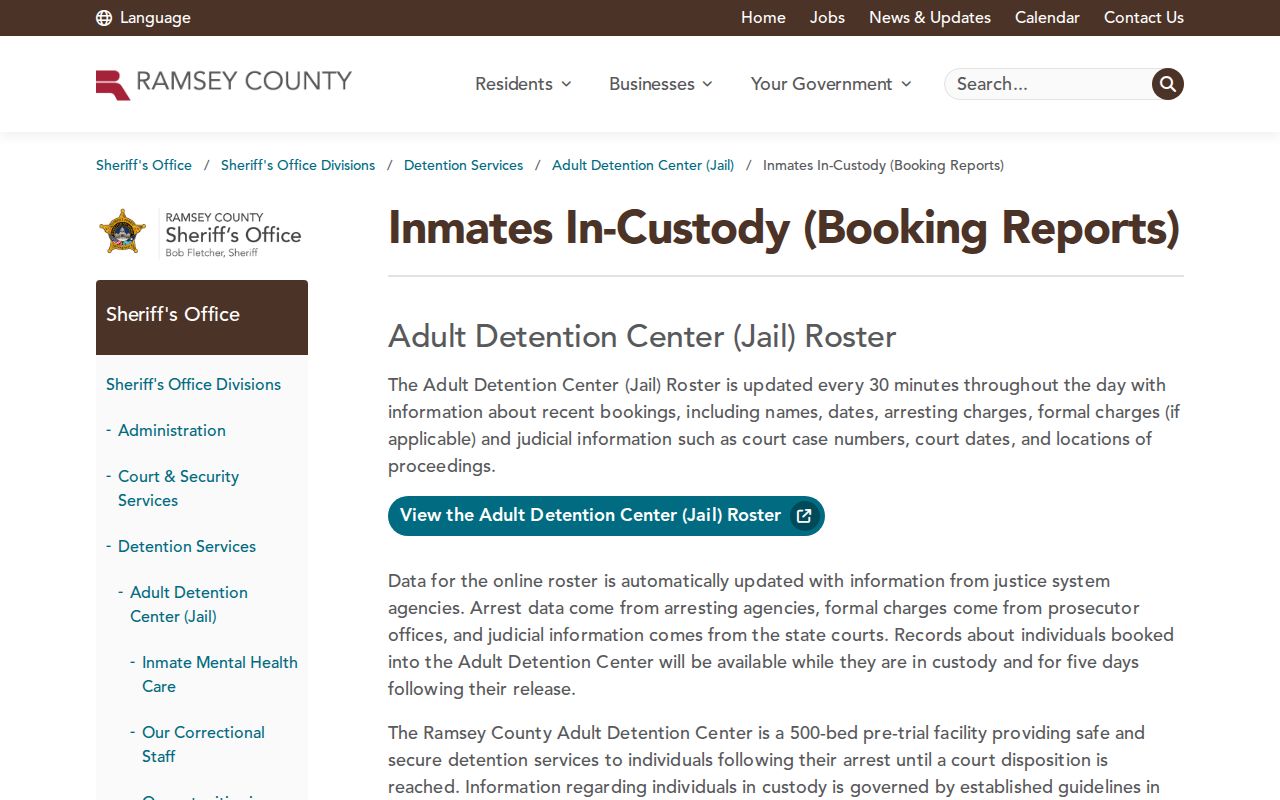
The Adult Detention Center roster is a time-limited custody record, not a general person search. Ramsey County says it refreshes every 30 minutes and covers people currently in custody plus five days after release. Captured fields include first and last name, age, and booking number, with booking, charge, court, and proceeding information where available.
The county custody-report page describes this publication window.
Booking information can change and does not establish a conviction. Use the court record for case status and formal outcomes.
Chapter 13 When Searches End
Minnesota’s Government Data Practices Act, Chapter 13, gives people a route to request existing public government data from the responsible authority. It also classifies private and nonpublic data. A strong request names the record, date range, format, and office likely to keep it. Asking for an existing permit file, tract-book entry, or older municipal record is more useful than asking an office to create a new resident list.
Ramsey County covers Saint Paul and many suburban municipalities, including Arden Hills, Falcon Heights, Maplewood, New Brighton, North Oaks, and North Saint Paul. Record the legal municipality, mailing city, ZIP, county, and precinct separately. Those labels can diverge, and the wrong custodian can make a valid search look empty.
Ramsey County Search Checks
Official sources and commercial people-search categories do different work. An official parcel account can show the tax name and legal property context. A recorded instrument can establish that a document was filed. A court docket can show case events subject to public-access limits. A commercial profile may combine public records and marketing data, but it can be stale, merge people with similar names, or lose the custodian’s limits and context.
| Official record route | Strength | Limit to remember |
|---|---|---|
| County parcel and tax record | Connects property to a current tax name | Does not list every occupant |
| Recorded deed index | Shows a documented land transaction | Older material may need an office or archive route |
| MCRO or court terminal | Shows public court activity | Remote results omit some cases and addresses |
| Library directory collection | Places a household in a historical year | Requires a second source to confirm identity |
When a record disagrees with another source, ask which office created it, when it was made, and what it was meant to document. A signed application, official copy, or custodian response has more weight than a search-result snippet. For a correction, contact the office that owns the record instead of copying the disputed data into another system.
Ramsey County Historical Directories
Ramsey’s historical trail reaches Newson and Barton’s Saint Paul directory in 1858 and 1859, St. Paul runs for 1863 through 1871 and 1873 through 1924, the Dual City Blue Book from 1885 through 1923, and Polk material from 1885 onward in captured examples. MNHS also preserves Ramsey civil case files from 1858 through 1902 and criminal files from before 1953. These collections make deep address research possible when a modern index ends.
Reverse and criss-cross directories work from an address to an occupant, while regular directories work from a name to an address. Exact local reverse-directory year runs need confirmation at the shelf or catalog. For a whole present-day street, use the property and map route in the Ramsey County Street Directory rather than assuming an old volume reflects today’s households.