
Ramsey County City Directory Shelves
St. Paul's historical shelf offers several distinct Ramsey County city directory series instead of one continuous publication. Newson and Barton produced the earliest captured run in 1858 and 1859. St. Paul directories then appear for 1863 through 1871 and 1873 through 1924, with a separate 1866 volume noted in local historical material. The Business Directory and Gazetteer survives for 1865 and 1878. Blue Books add a civic and social layer from 1885 through 1923, while R. L. Polk & Co. directories begin in the captured record in 1885. Examples for 1898, 1904, and 1909 are documented, but later continuity needs a catalog check.
| Directory collection | Years located | Research home | Useful detail |
|---|---|---|---|
| Newson and Barton, City of St. Paul | 1858-1859 | MNHS and RCHS historical collections | Earliest captured St. Paul run |
| St. Paul directories | 1863-1871; 1873-1924 | Online collection and library holdings | Annual urban name and address trail |
| Business Directory and Gazetteer | 1865; 1878 | Catalog and genealogy collections | Business and regional names |
| Dual City Blue Book | 1885-1923 | RCHS and MNHS collections | Civic and social listings |
| R. L. Polk & Co. | 1885 onward captured | FamilySearch, MNHS, library shelves | Addresses and household indicators |
The documented dates describe material located during research, not a promise that every annual issue survives or is online. Polk's Minneapolis suburban directory also covers Anoka, Hennepin, and Ramsey counties, but its exact run was not captured. Search the catalog for the municipality printed in an address before treating a St. Paul volume as a countywide answer.
Ramsey County Directory Access
The Minnesota Historical Society's Gale Family Library in Saint Paul is the main starting point for a Ramsey County city directory search. Its walk-in resources include genealogy databases, newspapers, maps, the 1895 Minnesota State Census index, and Digital Sanborn Maps. The State Archives also holds county and local-government material that can fill a gap left by a printed volume. Bring the surname, the city or municipality, an approximate year, and each address spelling already known.
This Minnesota Historical Society library image leads to the principal research collection for these historic volumes.
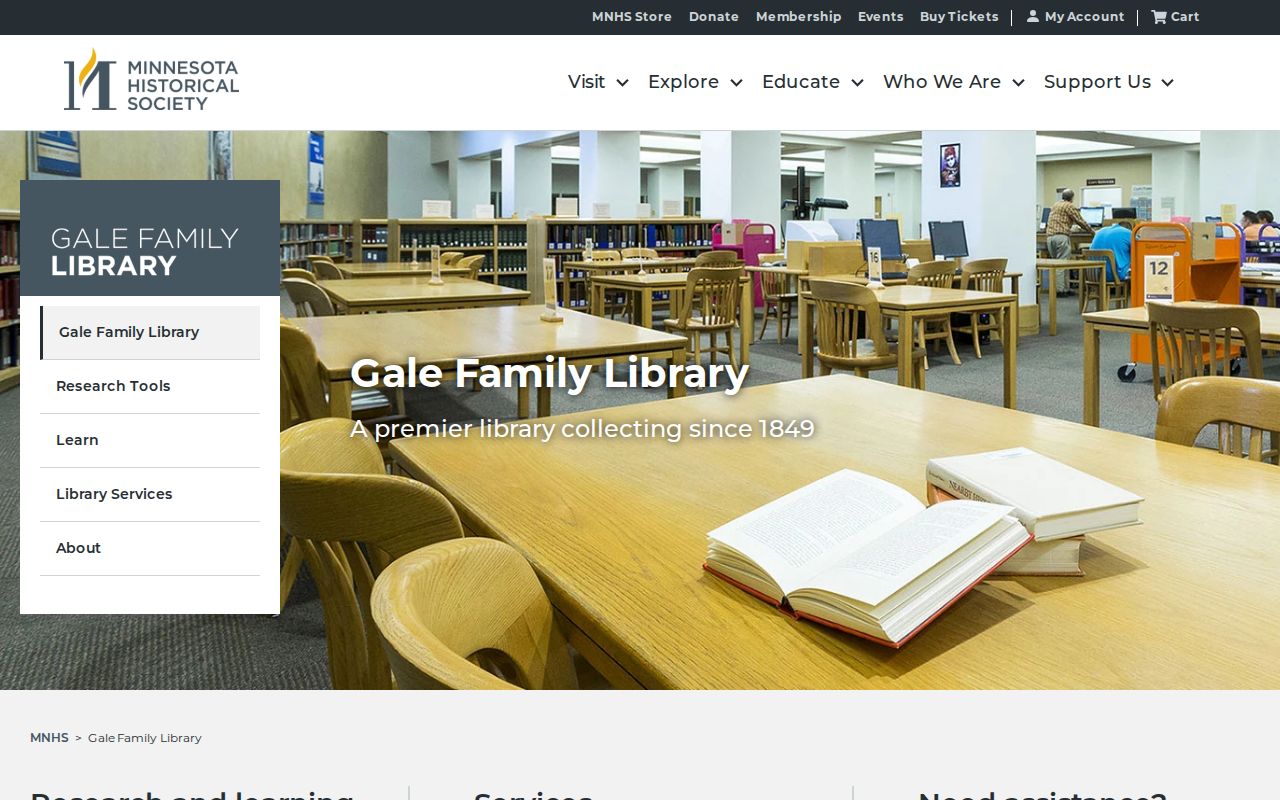
The library's tools work best alongside a catalog search, since a scan or physical volume may be limited by publisher, date, or access point. FamilySearch's St. Paul catalog is another structured route to city directories and related books. Ramsey County Historical Society's Research Center adds local photographs, manuscripts, maps, and Saint Paul subject files. Public-library local-history desks may also have telephone books, yearbooks, or microfilm, although branch-level year runs should be confirmed first.
Use companion collections when the directory supplies only a short entry. Gale Family Library holds books, serials, newspapers, maps, archival material, photographs, and genealogy databases. Its State Archives resources include local-government records, tax and assessment lists, school censuses, naturalization material, and railroad collections. A school yearbook, obituary, parish register, cemetery record, or newspaper notice may establish the relationship or life event that a printed entry merely hints at. Each source needs its own date and citation in the research notes.
Ramsey County Directory Timeline
The record sequence helps set realistic expectations before a name search. It begins with a short 1858-1859 run, then moves through several nineteenth-century St. Paul publications. The different series overlap in some years, so a missed surname in one volume should lead to another series rather than an immediate conclusion that the person was absent.
- 1858-1859: Newson and Barton publishes its Directory for the City of St. Paul.
- 1863-1871: Captured St. Paul directory material resumes, with a separately noted 1866 volume.
- 1865 and 1878: Business Directory and Gazetteer volumes provide additional regional context.
- 1873-1924: The documented St. Paul directory collection provides a long urban run.
- 1885 onward: Polk appears in the captured record, and the Dual City Blue Book runs from 1885 to 1923.
Publication title and city coverage matter. A person in Maplewood, New Brighton, or another Ramsey municipality may appear in a suburban, telephone, or local directory rather than in the main St. Paul alphabetical volume.
Reading Ramsey County Directory Entries
A printed Ramsey County city directory entry often packs several clues into one line. Alphabetical sections commonly give a surname and given name, then a spouse in parentheses or a widow notation, an occupation or employer, and a street address. Business sections can supply an office or company connection. The exact marks differ by publisher and year, so the abbreviation key near the title pages should be read before copying an interpretation into research notes.
| Name line | Surname, given name, initials, and sometimes a spouse or widow notation. |
|---|---|
| Occupation line | Work description and, in many entries, an employer or business connection. |
| Address | House number and street, subject to later street-name or numbering changes. |
| Household clue | Parentheses, “wid,” “bds,” or similar local abbreviations may qualify the listing. |
| Business section | Classified entries that can connect a name to an office, shop, or organization. |
- Criss-cross directory
- An address-ordered or reverse section that starts with a street and identifies the listed occupant or connection at that address.
- Householder index
- An alphabetical finding aid for the named person who heads or represents a listed household.
- Abbreviation key
- The publisher's explanation of short marks such as “r,” “h,” “wid,” “emp,” or “bds.” It varies by volume and should be checked in that volume.
Ramsey County Reverse Directories
Ordinary alphabetical volumes start with a name. A reverse or criss-cross directory reverses that question by arranging entries around a street address. That makes it useful for historic address research, especially after a person has been found in an alphabetical volume. Ramsey County research did not capture an official exact run for local reverse directories. Search the Gale Family Library, Ramsey County Library, and historical-society catalogs using “reverse,” “criss-cross,” “cross-reference,” “telephone directory,” and “suburban directory.”
Use the street spelling printed for that year. Old abbreviations, municipal boundaries, and street numbers can break a direct match. Compare the listing to a plat or map before assuming that an old number identifies the present parcel. Note: A reverse listing identifies a printed directory connection, not every person associated with an address.
Ramsey County Directory Census Pairing
Directories create close annual points, while census schedules show a household at spaced intervals. The 1895 Minnesota State Census is a particularly valuable Ramsey County bridge and is available through the MNHS library environment. Federal schedules can be paired with 1870, 1880, 1900, 1910, 1920, 1930, 1940, and 1950 directory-era research, subject to the federal 72-year release rule for more recent images.
- Choose a dated directory edition close to the known event or address.
- Record the name form, spouse clue, occupation, employer, and exact printed address.
- Search the next earlier and later editions for an arrival, move, name change, or “removed to” note.
- Pair the closest directory years with the 1895 Minnesota census or a released federal census.
- Compare street, age, relatives, and occupation before deciding that two similar names are the same person.
A disappearance can mean a move, death, a boarding arrangement, a rural route, a missed publication, or a spelling and indexing problem. Newspapers, obituaries, cemetery records, and probate materials can help distinguish those possibilities.
Ramsey County Directory Map Checks
Sanborn fire-insurance maps test the building side of a Ramsey County directory find. Captured St. Paul map years are 1885, 1903, and 1926. A sheet can show a building footprint, construction material, stories, use, and the street pattern at the time. It can establish that a structure stood at a location or changed form, but it does not name every person connected with it.
The Library of Congress St. Paul Sanborn record provides a public entry point, while MNHS offers Digital Sanborn access to walk-in researchers. Match the directory year as closely as possible to the map year, then compare the block, lot, and street grid. That extra check is especially useful where an address has been renumbered or a municipal line changed.
Ramsey County Directory Archives
Directory work can lead into records preserved outside the volume itself. Minnesota Historical Society holds Ramsey civil case files from 1858 through 1902 and pre-1953 criminal files, according to the Minnesota Judicial Branch. Those holdings can help place a historical name in a dated record trail when an appropriate file is available. Current court information and certified copies remain matters for court administration, not a substitute for the printed directory.
The family-history value comes from keeping the sources separate. A printed directory supplies a name-and-address snapshot. A census supplies a household snapshot. A deed or court record serves a different purpose. Note: Save the volume title, year, page, and all spelling variants with each Ramsey County directory find.
Ramsey County Directory Gaps
Not all of Ramsey County shares St. Paul's documentation. Saint Paul is the dominant historic records center, but the county includes Arden Hills, Falcon Heights, Gem Lake, Lauderdale, Little Canada, Maplewood, Mounds View, New Brighton, North Oaks, North Saint Paul, and other municipalities. City name, mailing city, ZIP, and county can diverge. Record the municipality exactly as printed before searching an archive.
Local spelling also matters. Directory publishers may compress compound surnames, initials, translated names, and street abbreviations. Search variants and inspect nearby alphabetic entries. A printed directory is strongest when paired with the edition's own key, a compatible map, and a second dated record.
County geography adds another check. Saint Paul is the county seat and the main historic directory center, but a later suburban address may need a municipal file, a county parcel record, or a different local-history shelf. Start with the jurisdiction printed in the historical source, then compare it with the modern municipality only after the street and legal land description have been reconciled.